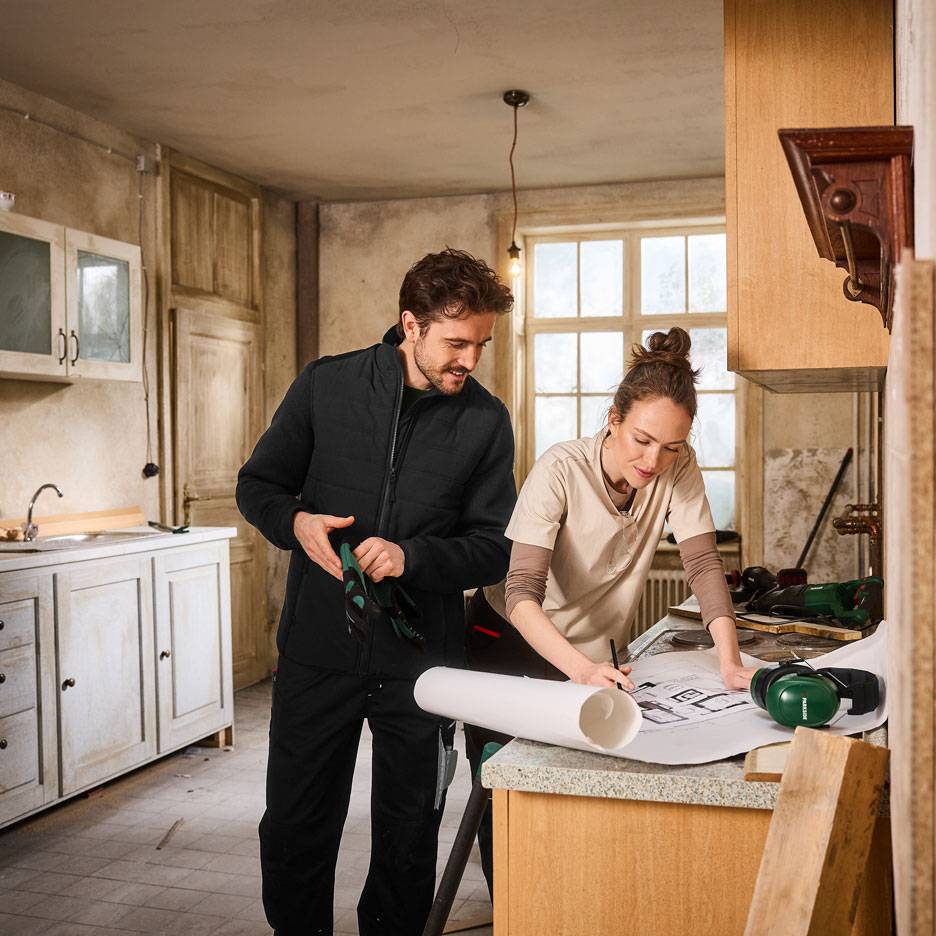
Creating a Wall Opening: Guide & Tips
Turn two rooms into one, or a small space into a large one: creating an opening in a wall lets you design your home exactly how you want it. But should you just grab a sledgehammer and get started? It's best not to! We've got tips for both load-bearing and non-load-bearing walls. We'll show you what to look out for, what costs to expect, and which tools will help you succeed with your DIY wall opening project.

Knocking through a wall checklist: What you need to check first
- Written permission if you're renting
- Building plan for your home
- A structural survey
- Planning permission, if required
You can get the building plan from your local planning authority. This will show you which walls are load-bearing, where pipes and wiring run, etc. Planning permission is necessary if:
- the opening affects a load-bearing wall,
- it involves an external wall,
- the building is a listed building.
Top tip: When tackling a major project like knocking through a wall, it's always best to play it safe. Consult your local planning authority and a structural engineer beforehand. This can save you from nasty surprises, and could prevent you from having to undo the work or face hefty fines.
Load-bearing vs. non-load-bearing walls – how to tell the difference
Only a structural engineer can tell you for sure what type of wall you're dealing with, but there are some rules of thumb. The following are usually considered load-bearing walls:
- Exterior walls
- Walls with a thickness of 17.5 cm or more
- Masonry walls of 11.5 cm or more (in buildings built after 1990)
It gets more complicated with older buildings, so getting expert advice is especially important here.
You can often identify non-load-bearing walls by their sound: if a wall sounds hollow when you knock on it, it’s probably a plasterboard wall, which you can generally remove – as long as there are no pipes or wiring in the way!

What tools do you need for a wall breakthrough?
To knock through a wall, you'll need to bring out the heavy-duty kit. The most important power tools and hand tools are:
- Rotary hammer: A powerful tool for getting through solid masonry
- Sledgehammer: When you need brute force – perfect for the initial breakthrough
- Angle grinder (with a diamond cutting disc): For cutting into plasterboard or lightweight blocks
- Hammer & chisel: The experts for fine-tuning and lighter materials
- Core drill: For precise, circular openings for pipes
Tool Tip: For thin walls like plasterboard or similar materials, your hammer drill should have an impact energy of 10 to 20 joules; for thicker walls, 20 to 50 joules are needed.

Creating an opening in a non-load-bearing wall: Guide & tips
Creating an opening in a load-bearing wall is a job for the professionals. To make an opening in a non-load-bearing wall, follow these steps:
- Tools: Get your tools ready and put on your protective gear (ear defenders, safety goggles, protective clothing, work gloves, safety boots).
- Cover adjacent rooms with dust sheets – including floors, walls and furniture.
- Mark the opening – especially if it's for a door or window. It's best to mark it slightly larger than needed.
- Use a sledgehammer or rotary hammer to first chisel off the plaster, then switch to the drill function. Drill a hole every 5–10 cm along the line of the opening.
- Remove the rubble, install the door or window, and plaster the opening – for example, with plasterboard or plaster. Fill any gaps with expanding foam or cement.
Knocking Through a Wall: Calculating the Costs Correctly
How much it will cost to knock through a wall depends on many factors. There are various ways to calculate the cost, which mainly depend on whether you hire professionals or do it yourself. On top of this, you have labour costs for tradespeople, as well as call-out fees, costs for rerouting pipes or wires, etc. Get a quote from a local professional and compare the offers. When you do, don't just look at the final price, but pay close attention to the scope of services included!